Fruit Juice or Whole Fruit: Does It Matter?
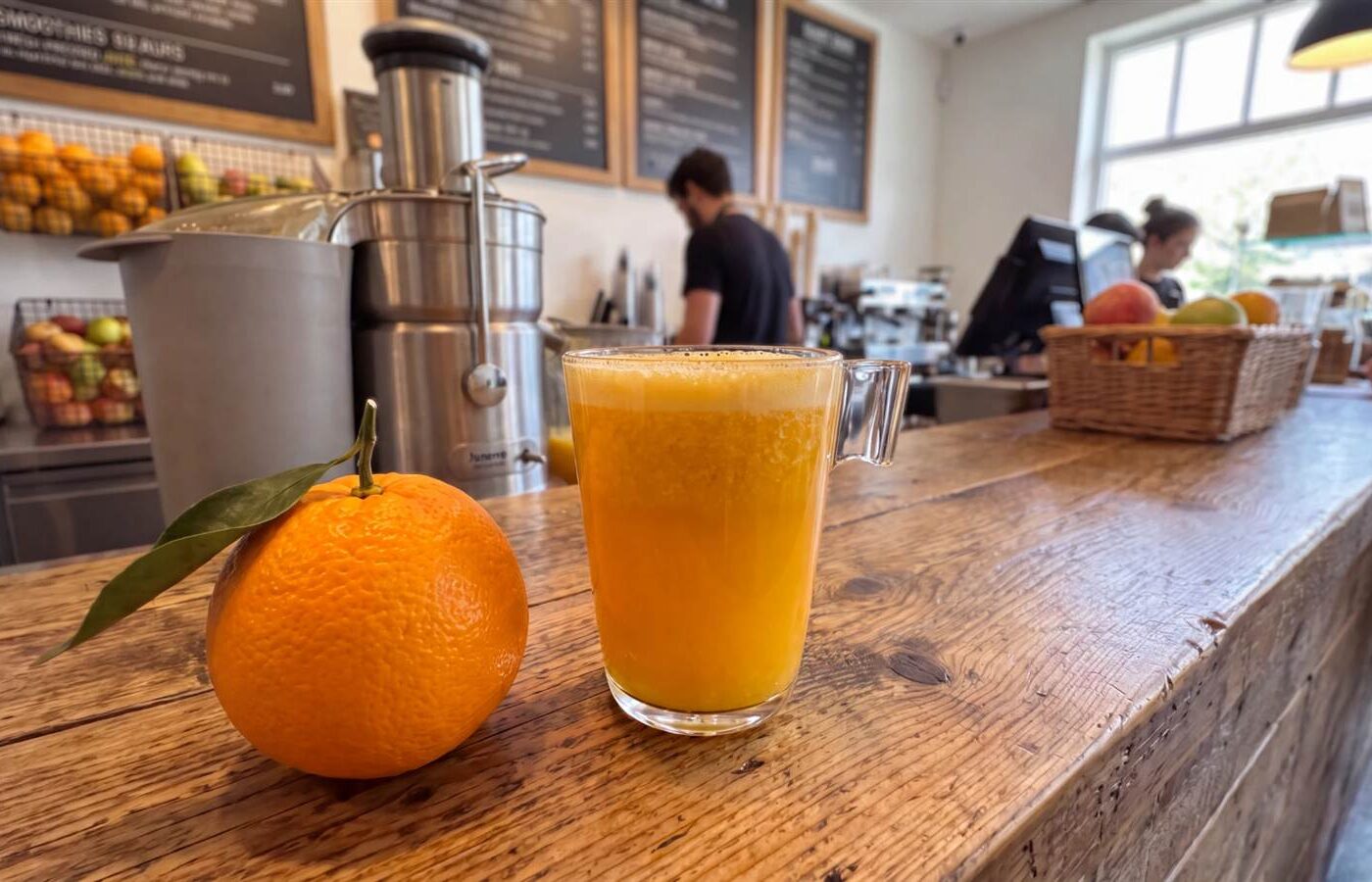
A glass of orange juice and a whole orange come from the same fruit, so it is natural to wonder whether they are basically the same. Large studies suggest they behave quite differently in the body. This guide looks at what is different, what researchers found, and how to enjoy both sensibly. It is general education, not medical advice.
What changes when fruit is juiced
- Less fiber. Juicing removes most of the fiber, which normally slows digestion and helps you feel full.
- Faster to drink than to eat. It takes a few minutes to eat three oranges and seconds to drink the juice of three. Liquid calories tend to be less filling.
- Concentrated sugar. A glass of juice can hold the sugar from several pieces of fruit, without the chewing that comes with them.
- Some nutrients remain. 100 percent juice still provides vitamin C, potassium and other nutrients, which is why it is not the same as a soft drink.
A big long-term study
In 2013, researchers led by Isao Muraki at the Harvard T.H. Chan School of Public Health published a study in the BMJ that pooled three long-running U.S. cohorts, the Nurses’ Health Studies and the Health Professionals Follow-up Study. They followed about 187,000 adults for more than two decades, during which about 12,000 developed type 2 diabetes. For every three servings per week:
- Blueberries were linked to about 26 percent lower risk of type 2 diabetes.
- Grapes and raisins were linked to about 12 percent lower risk.
- Apples and pears were linked to about 7 percent lower risk.
- Fruit juice was linked to about 8 percent higher risk.
Whole fruit overall was only weakly protective on average, and the associations differed from fruit to fruit.
How to read it
- It is observational. People who eat more whole fruit may differ in other healthy ways. The study cannot prove cause and effect.
- The differences are modest. The percentages are relative risks, and they reflect averages over many years.
- The direction is consistent with the science. Fiber, chewing and slower absorption are plausible reasons whole fruit behaves differently.
Everyday takeaways
- Make whole fruit the default. Keep fruit where you can see it. Our guide to frozen, canned or fresh produce applies to fruit, too.
- Keep juice small. If you enjoy it, a small glass with a meal is a reasonable choice.
- Watch the labels. “Juice drink,” “cocktail” and “beverage” often mean added sugar. See reading a nutrition label.
- Do not forget fiber. It is one of the quiet reasons whole fruit works well. See fiber.
- People managing diabetes should ask their care team how fruit and juice fit their plan.
A balanced view
Juice is not a villain, and whole fruit is not magic. But if you are choosing between them most of the time, the whole fruit is the better everyday habit.
Sources
- Muraki I, Imamura F, Manson JE, et al. Fruit consumption and risk of type 2 diabetes: results from three prospective longitudinal cohort studies. BMJ, 2013;347:f5001 (with a published erratum).
- U.S. Department of Health and Human Services and U.S. Department of Agriculture. Dietary Guidelines for Americans.
Weight Wire is free to read. A free account lets you save articles and use the private journal and food lookup, which are free to use too. Create my free account

Weight Wire Editorial Team
Writer at Weight Wire.