Screens Before Bed: Does Blue Light Really Keep You Up?
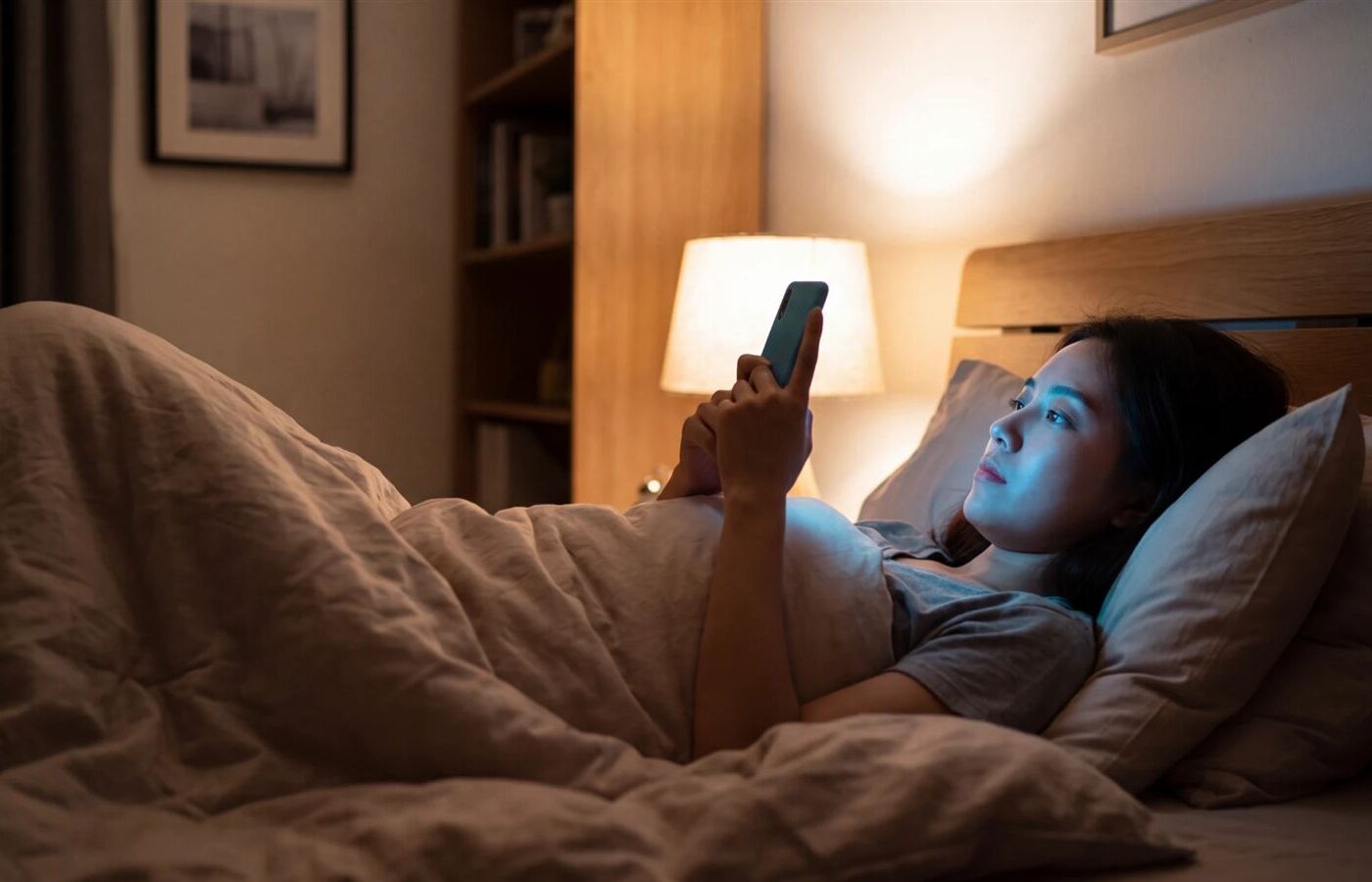
Phones, tablets and laptops give off blue-enriched light, and for years we have been told that this is why scrolling in bed makes it hard to sleep. There is truth in it, and some exaggeration. This guide looks at what a well-known experiment showed, what blue-light glasses seem to do, and simple steps that make a difference. It is general education, not medical advice.
How light affects sleep
Your body clock uses light to tell what time it is. Bright, bluish light in the evening can tell your brain it is still daytime, which delays the release of melatonin, the hormone that helps you feel sleepy. Daylight is the strongest signal. Screens are much weaker, but they are close to your face and used late at night.
The e-reader experiment
In 2015, researchers at Brigham and Women’s Hospital in Boston, led by Anne-Marie Chang, published a study in the Proceedings of the National Academy of Sciences. Twelve healthy adults spent several nights in a sleep lab. For five evenings they read from a light-emitting e-reader for four hours before bed, and for five evenings they read a printed book in dim light.
- Melatonin rose later in the evening when reading on the device.
- It took about ten minutes longer to fall asleep, and there was less REM sleep.
- People felt less alert the next morning, and their body clocks shifted later.
Reasons for caution
- It was tiny. Twelve people, in a lab, for a handful of nights.
- Four hours of reading is a lot. Real-life evenings vary, and so does screen brightness.
- Content matters too. Stressful emails and exciting videos keep the mind busy, regardless of light.
What about blue-light glasses?
A 2023 Cochrane review pooled 17 randomized trials with 619 people. It found that blue-light filtering lenses may not reduce eye strain from computer work, and probably do not improve sleep quality. The trials were short and small, so the question is not fully settled, but there is no strong case for buying them.
Simple changes that tend to help
- Wind down earlier. Stop screens 30 to 60 minutes before bed, when you can.
- Dim the screen and keep it farther from your face in the evening.
- Use the night setting if you like it. Its benefits are not well proven, but it does little harm.
- Charge the phone away from the bed. It removes the temptation to check it.
- Get bright light early in the day. Morning daylight strengthens your body clock.
- Keep a regular schedule. Our sleep basics guide covers the habits that help.
Why it matters for health
Poor sleep affects appetite and cravings, as we explain in our guide to sleep and weight. If you use a tracker to monitor it, our guide to sleep trackers explains what the numbers can and cannot tell you.
In short
Evening screens can nudge your body clock later, and it is reasonable to limit them. But the blame for poor sleep is rarely just blue light. If your nights are restless, look at the whole routine, and talk to a clinician if problems continue.
Sources
- Chang AM, Aeschbach D, Duffy JF, Czeisler CA. Evening use of light-emitting eReaders negatively affects sleep, circadian timing, and next-morning alertness. Proceedings of the National Academy of Sciences, 2015;112(4):1232-1237.
- Singh S, Keller PR, Busija L, et al. Blue-light filtering spectacle lenses for visual performance, sleep, and macular health in adults. Cochrane Database of Systematic Reviews, 2023 (CD013244).
Weight Wire is free to read. A free account lets you save articles and use the private journal and food lookup, which are free to use too. Create my free account

Weight Wire Editorial Team
Writer at Weight Wire.