Continuous Glucose Monitors Without Diabetes: How Useful Are They?
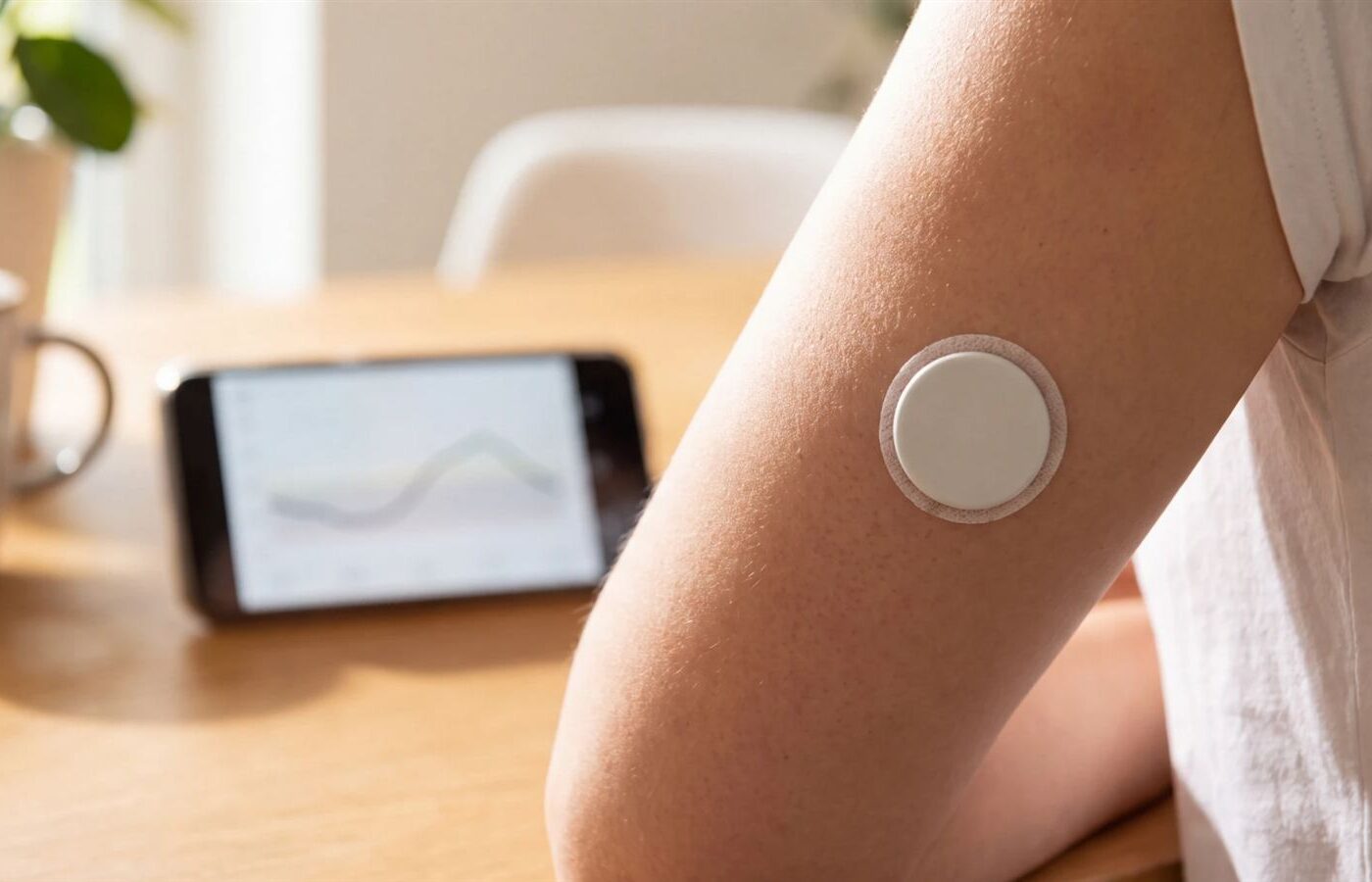
Continuous glucose monitors, or CGMs, are small sensors worn on the skin that track blood sugar all day. For people with diabetes they are an established tool. Since 2024 they have also been sold over the counter to people without diabetes who want to see how food and exercise affect them. This guide looks at what the research says about that use. It is general education, not medical advice, and it does not recommend any device.
What a CGM does
A thin sensor, usually worn on the arm, measures glucose in the fluid under the skin every few minutes and sends the readings to a phone. The point is to show patterns: how levels rise after a meal, what happens during a walk, how sleep changes things.
Why they are now sold to everyone
In 2024 the FDA cleared the first over-the-counter CGM systems for adults who do not use insulin, including people without diabetes who want to understand how diet and activity affect them. That clearance covers safety and basic accuracy. It does not mean there is proof that wearing one improves health in people without diabetes.
Do they help people without diabetes?
A 2024 systematic review reported by University College London found that there was little published evidence on how accurate CGMs are in people who do not have diabetes, and not enough evidence to say what health benefits the information would bring. Other reviewers have noted that no large randomized trial has shown that CGM use helps adults without diabetes change their diet or exercise in a lasting way. Researchers have also raised concerns about possible unintended effects, calling for clearer regulation.
Normal ups and downs
Blood sugar in healthy people rises after eating and falls again, and it varies with sleep, stress, illness and activity. Seeing a number go up after a meal is normal, not a sign of a problem. Without guidance on what a “normal” reading looks like, it is easy to read too much into a chart.
Possible downsides
- Anxiety and over-focus. Constant numbers can make ordinary food feel risky, which can push some people toward unnecessary restriction.
- Cost. Sensors need replacing regularly, so the cost adds up.
- Unclear action. Even if you learn that a food raises your reading, the research does not yet tell us what to do with that, or whether it improves long-term health.
- Accuracy. Sensors measure fluid under the skin, not blood directly, and readings can lag or differ from a finger-stick or lab test.
Who may actually benefit
People with diabetes, especially those using insulin, have clear evidence of benefit and should use a CGM under their care team’s guidance. For everyone else, it is best seen as a curiosity tool rather than a proven health tool. If you have a family history of diabetes, high readings on a lab test or symptoms like unusual thirst, a clinician can order proper testing that is more informative than a consumer sensor.
If you are curious anyway
- Treat the data as a rough picture, not a diagnosis.
- Do not change medications or cut out whole food groups based on a chart.
- Set a short trial period rather than wearing one indefinitely, and stop if it causes stress.
- Bring any concerning pattern to a clinician instead of trying to solve it yourself.
If tracking numbers ever leaves you worried or out of control around food, a licensed professional can help. In the U.S. you can call or text 988 at any time. For other ways data can mislead, see our guides to calorie-burn numbers on fitness trackers and calorie-tracking apps.
Where this leaves us
Glucose monitors for people without diabetes are cleared for sale, but the research on whether they help is thin. They can be interesting. They are not a shortcut to better health, and the numbers are easy to over-read.
Sources
- U.S. Food and Drug Administration, announcements on over-the-counter continuous glucose monitors, 2024.
- University College London, news release on a 2024 systematic review of glucose monitors in people without diabetes.
- Clinical Correlations (NYU Langone), “Could Adults Without Diabetes Benefit from Continuous Glucose Monitoring?” May 2025.
Weight Wire is free to read. A free account lets you save articles and use the private journal and food lookup, which are free to use too. Create my free account

Weight Wire Editorial Team
Writer at Weight Wire.