Muscle and Fat: The Real Calorie Difference
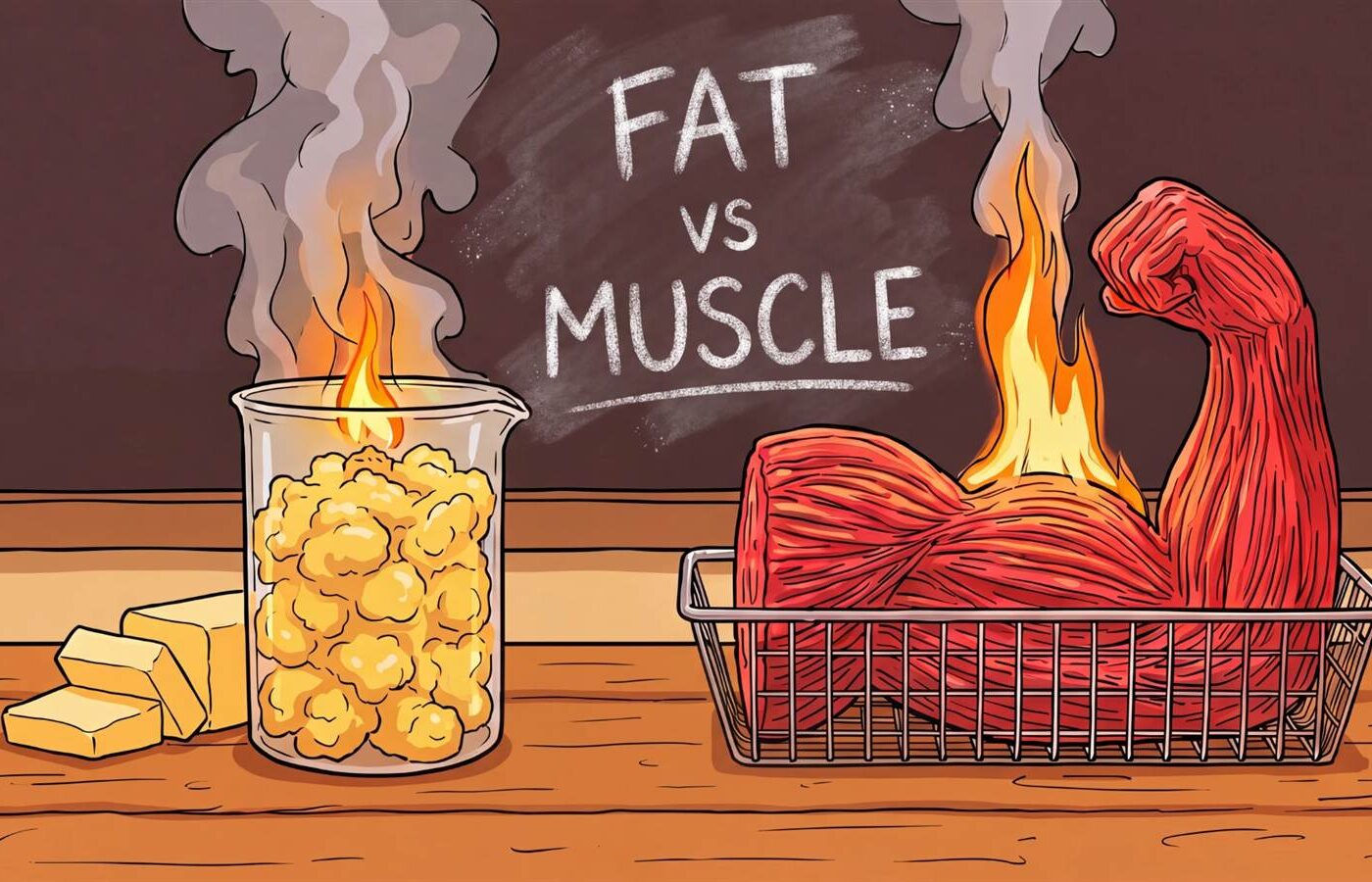
“Muscle burns more calories than fat” is one of the most repeated lines in fitness. It is true, but the real numbers are smaller than the slogan suggests. Here is what the measurements say, and why that still matters. This is general education, not medical advice.
Where the numbers come from
In 1992, researcher Marinos Elia published a review listing how much energy each organ and tissue uses at rest, per kilogram. Those values have been tested since, including in a 2010 study by Zimian Wang and colleagues in the American Journal of Clinical Nutrition that checked them against measured data in adults.
- Skeletal muscle: about 13 calories per kilogram per day.
- Fat (adipose) tissue: about 4.5 calories per kilogram per day.
- Liver: about 200; brain: about 240; heart and kidneys: about 440.
A later study in women with obesity found very similar numbers (about 12.7 for muscle and 4.4 for fat).
What that means in plain terms
Muscle burns roughly three times as much as fat at rest, but both are low compared with the organs. So if you replaced one kilogram of fat with one kilogram of muscle, you would burn only about 8 to 9 more calories a day. Adding about 4.5 kilograms (10 pounds) of muscle would raise your resting burn by something like 40 calories a day, which is about a small handful of nuts.
That is why gaining muscle is not a quick route to a much bigger calorie budget. It is also why the common claim that a pound of muscle burns “50 extra calories a day” overstates the case.
Why muscle still matters
- It costs energy to use. Moving, lifting and everyday activity burn far more than resting muscle does. Muscle lets you do more of it.
- It protects function. Strength supports balance, independence and joint health as we age, which is the larger payoff.
- It matters during weight loss. Keeping muscle while losing fat keeps your resting burn from falling more than it needs to. Our guide to muscle loss on GLP-1 medications covers why this is a concern with fast weight loss.
- It helps blood sugar. Working muscles take up glucose, which is part of why activity after meals helps.
The bigger energy picture
Most of your daily energy goes to organs that run constantly, plus movement and digestion. Our guide to the thermic effect of food and the one on everyday movement show where much of the rest comes from. And if you wonder why your metabolism seems to change with age, see does your metabolism really slow down with age.
A fair way to put it
Muscle is metabolically a bit more active than fat, but the difference at rest is modest. The reason to build or keep muscle is less about the calorie math and more about what it lets you do for decades. A simple start is in our guide to strength training for beginners.
Sources
- Elia M. Organ and tissue contribution to metabolic rate. In: Kinney JM, Tucker HN, eds. Energy Metabolism: Tissue Determinants and Cellular Corollaries. Raven Press, 1992.
- Wang Z, Ying Z, Bosy-Westphal A, et al. Specific metabolic rates of major organs and tissues across adulthood: evaluation by mechanistic model of resting energy expenditure. American Journal of Clinical Nutrition, 2010;92(6):1369-1377.
Weight Wire is free to read. A free account lets you save articles and use the private journal and food lookup, which are free to use too. Create my free account

Weight Wire Editorial Team
Writer at Weight Wire.