Treadmill Desks: Does Walking While You Work Add Up?
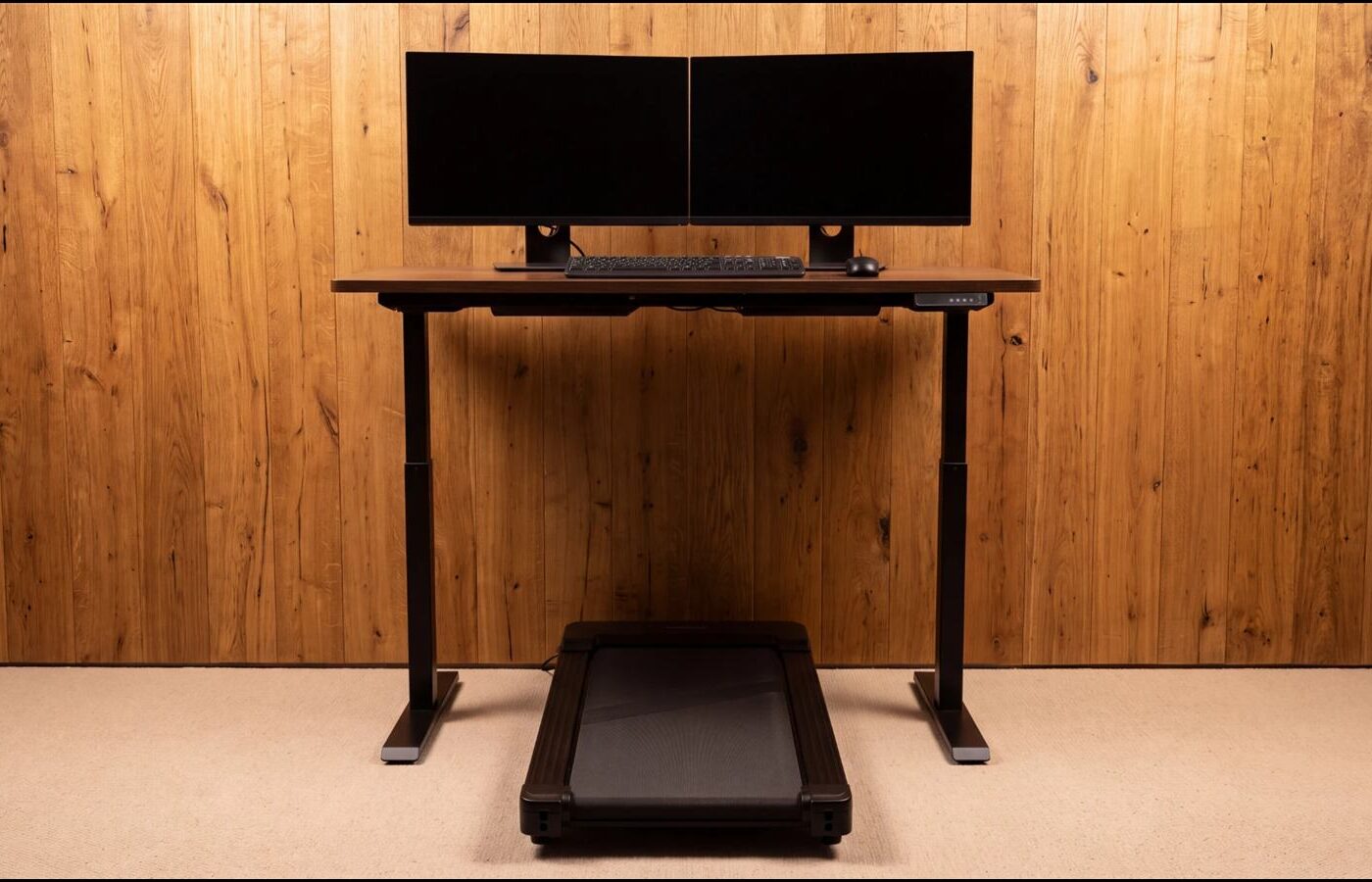
The idea is appealing: instead of sitting through the workday, you walk slowly on a treadmill under your desk while you answer email. A treadmill desk, or “walking pad,” promises extra movement without carving out time for exercise. It has been studied since the mid-2000s. This guide explains what the research says it adds up to, what it cannot promise, and how to try it if you are curious. It is general education, not medical advice.
What walking while you work burns
The first study that got attention came from Mayo Clinic researchers James Levine and Jon Miller in 2007. Fifteen sedentary adults with obesity measured their energy use while sitting at a desk, standing, and walking at a pace they chose themselves, which averaged about 1.1 miles an hour. Walking and working used on average about 119 calories an hour more than sitting, with the seated rate around 72 calories an hour.
A later review pooled 13 studies with 351 people and landed in a similar place: roughly 100 calories more per hour than sitting, with a range of about 90 to 120. That is real, though it is modest. An hour of slow walking at a desk is closer to a small snack than a large meal.
What happened over a year
In 2013, a Mayo Clinic team followed 36 office workers who had their desks replaced with treadmill desks for a year. They were lean, overweight or had obesity. On average, they lost about 1.4 kilograms (about 3 pounds), and those with obesity lost about 2.3 kilograms (about 5 pounds). Their daily activity rose, and their work performance did not suffer.
- There was no comparison group. Everyone used the desk, so the study cannot separate the desk’s effect from the effects of being in a study.
- The range was wide. Some people lost much more and some gained.
- It was small and voluntary. People who volunteer for a treadmill desk tend to be keen on it.
- Projections are not results. Early articles estimated large yearly weight changes if someone walked for hours daily. That was arithmetic, not something measured.
The bigger picture
A large Cochrane review of workplace efforts to reduce sitting looked at 34 studies. It found very low-quality evidence that sit-stand desks cut sitting by roughly one and a half to two hours a working day, and concluded that there was not enough evidence on treadmill desks specifically to say much. Standing and moving more did not appear to cause harm or reduce productivity in the studies reviewed.
Does it get in the way of work?
This is where results are mixed. Reviews find little effect on overall work performance, but some studies show typing speed and accuracy drop at faster walking speeds, and fine detail work such as precise mouse tasks can be harder. Slow walking, around 1 mile an hour, tends to work best.
If you want to try it
- Start slowly. Walk at a gentle pace for 10 to 15 minutes at a time, and build up over weeks.
- Match the task. Calls, reading and email suit walking. Spreadsheets and detailed editing may be easier seated.
- Wear stable shoes and keep the machine clear of cords and clutter.
- Use it as one tool. Alternating sitting, standing and walking is a reasonable pattern.
- You do not need a machine. Standing during calls, a lap of the office each hour or a short walk after lunch add up in the same way. Our guide to NEAT explains how everyday movement counts, and our guide to using your phone as a pedometer shows a free way to track it.
- Check with a clinician if you have balance problems, joint pain, heart or blood pressure concerns, or are pregnant.
The takeaway
A treadmill desk can reliably add a modest amount of movement to a sitting-heavy day, and for some people that is enough reason to enjoy one. It is not a weight-loss device on its own, and the evidence for large changes is thin. What matters most is moving a bit more across the whole day, with or without the equipment. Our guides to the 10,000-steps myth and how much walking is enough put it in context.
Sources
- Levine JA, Miller JM. The energy expenditure of using a “walk-and-work” desk for office workers with obesity. British Journal of Sports Medicine, 2007;41(9):558-561.
- Koepp GA, Manohar CU, McCrady-Spitzer SK, Ben-Ner A, Hamann DJ, Runge CF, Levine JA. Treadmill desks: a 1-year prospective trial. Obesity, 2013;21(4):705-711.
- Oye-Somefun A, et al. A systematic review and meta-analysis of the effect of treadmill desks on energy expenditure, sitting time and cardiometabolic health in adults. BMC Public Health, 2021.
- Shrestha N, Kukkonen-Harjula KT, Verbeek JH, Ijaz S, Hermans V, Pedisic Z. Workplace interventions for reducing sitting at work. Cochrane Database of Systematic Reviews, 2018 (CD010912).
- MacEwen BT, MacDonald DJ, Burr JF. A systematic review of standing and treadmill desks in the workplace. Preventive Medicine, 2015;70:50-58.
Weight Wire is free to read. A free account lets you save articles and use the private journal and food lookup, which are free to use too. Create my free account

Weight Wire Editorial Team
Writer at Weight Wire.