Meal Timing: Does When You Eat Matter as Much as What You Eat?
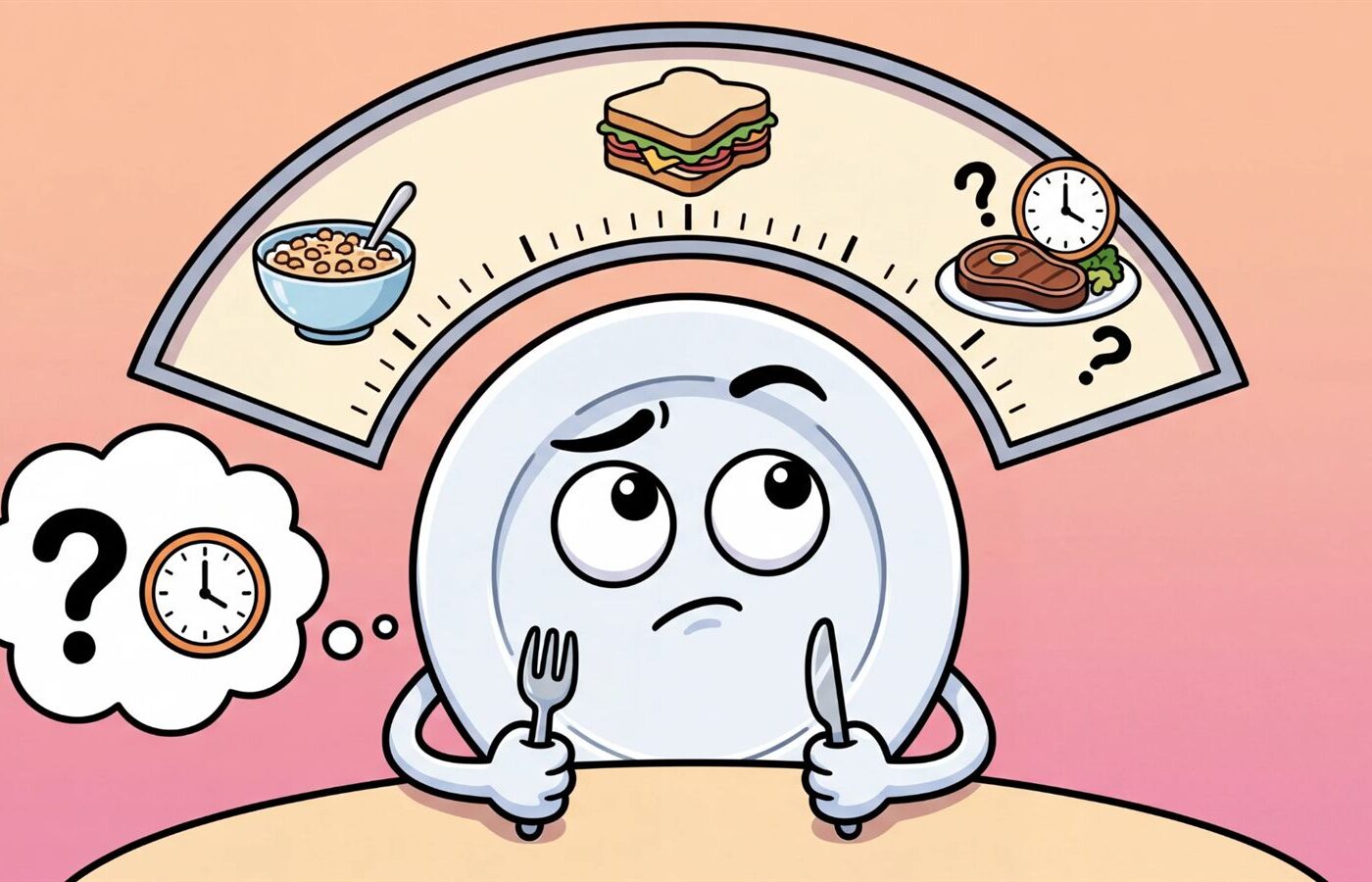
“It’s not just what you eat, it’s when you eat it” has become a popular idea. Meal timing, sometimes called chrononutrition, covers everything from skipping breakfast to eating late at night. Here is what one often-cited study found, what it cannot tell us, and how to think about timing without turning it into another rule. It is general education, not medical advice.
The study people keep citing
In 2013, a team led by Marta Garaulet published a study in the International Journal of Obesity. It followed 420 people with overweight or obesity during a 20-week weight-loss program in Spain. Most of the group’s calories came at lunch, the main meal in that culture, so the researchers sorted people by when they ate it.
- Early eaters had their main meal before 3 p.m. (about half the group).
- Late eaters ate it after 3 p.m. (the other half).
What they found
- Late eaters lost less weight. They lost weight more slowly and lost less overall during the 20 weeks.
- It was not explained by the usual suspects. The groups did not differ in total calories eaten, estimated energy expenditure, appetite hormone levels, sleep duration or other measured factors.
What it cannot tell us
- It was an observational comparison. People were not assigned to eat early or late. Something else about people who eat late, such as sleep patterns, work schedules or habits, may explain some of the difference.
- It was one program in one country. The findings may not apply to cultures where the largest meal is dinner.
- Food intake outside meals was not the focus. Snacking and late evening eating are hard to capture.
What other research suggests
Studies that actually assign people to eat at set times are small and mixed. Some suggest that eating earlier in the day may improve blood sugar and appetite signals. Others find little difference in weight when total calories are held the same. Our guides on intermittent fasting and on whether you need breakfast look at the related evidence.
Putting it to use without stress
- Notice your own pattern. A few days of jotting down when you eat can show whether most of your food comes late, and how you feel afterward.
- Consider moving a little earlier, if it is easy. A slightly larger lunch and a lighter evening is a gentle experiment, not a rule.
- Keep the evening kitchen calm. Late-night eating is often driven by hunger earlier in the day or by stress. Our stress eating guide has more.
- Work with your life. Shift workers, parents and people with medical conditions may have limited choices. Consistency matters more than a perfect clock.
The short version
Timing appears to matter for some people, but it is one factor among many, and the strongest evidence is still observational. If eating a bit earlier fits your day, it is a reasonable thing to try. If it does not, there is plenty else to focus on.
Sources
- Garaulet M, Gómez-Abellán P, Alburquerque-Béjar JJ, Lee Y-C, Ordovás JM, Scheer FAJL. Timing of food intake predicts weight loss effectiveness. International Journal of Obesity, 2013;37(4):604-611.
- ScienceDaily summary of the study, January 2013, and coverage by FoodNavigator-USA, February 2013.
Weight Wire is free to read. A free account lets you save articles and use the private journal and food lookup, which are free to use too. Create my free account

Weight Wire Editorial Team
Writer at Weight Wire.